
Design research
Every curve has a story
The geometry of Rajasthan’s mirror palaces: how each curve is drawn, where it comes from, and why it has lasted

The mirror palaces of Rajasthan look like pure abundance: glass on every surface, flowers in every corner. Look closer and they are built from a small number of curves, each drawn with a compass and a straight edge, each carrying a meaning that is older than the palace itself.
This study follows those curves one by one. For each, we show how it is constructed, the palace form it comes from as we drew it, the story behind it, and why it matters in art. Every mirror we make carries one of them.
The jharokha arch
झरोखा · jharokha
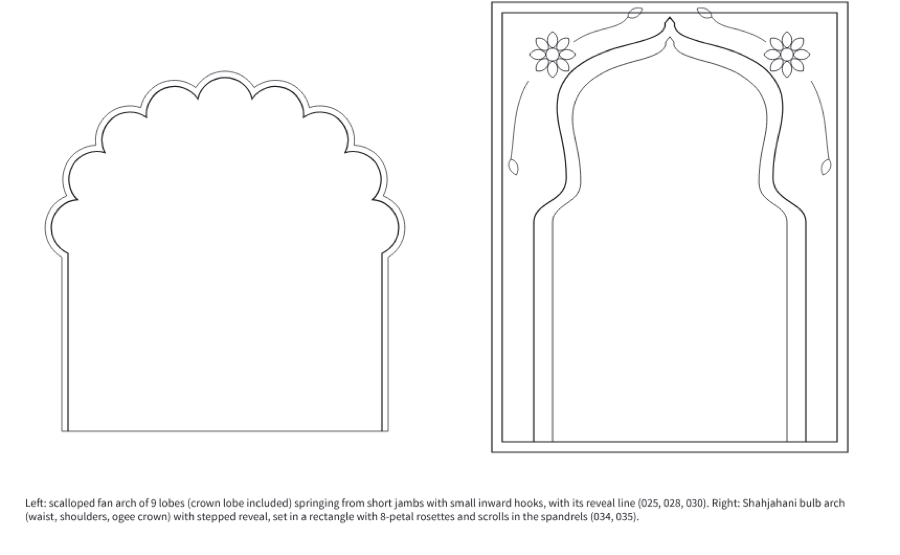
How it is drawn
- Draw the springing line and mark the two jambs.
- From a centre C₁ on the springing line, swing a convex arc up from the jamb.
- From a second centre C₂, level with the apex and outside the arch, swing a concave arc down to meet it.
- The two arcs touch at one point, T, and share a tangent there, so the curve turns from swelling to tapering without a break.
- Mirror the construction about the centre line; the two concave arcs meet in a point, the apex.
The story
A jharokha is a balcony window that projects from the wall on brackets, closed by an arch and often by a carved screen. In the palaces of Rajasthan it let the women of the court watch processions, festivals and the court below without being seen.
It also worked the other way. At the Mughal court, and at Rajput courts after it, the ruler appeared to his people each morning at a jharokha, a custom called jharokha darshan, the “viewing at the window”. The same opening was a place to look out from, and a place to be looked at.
Why it matters
The ogee is a curve that changes its mind: it swells like a dome, then tapers like a flame. That double movement is why it reads as alive, as a bud about to open or a flame rising, and why it has crowned windows from Rajasthan to the Gothic cathedrals of Europe. Framing a face, it lifts the eye upward.
In our mirrorsJharokha Mini · Haath Aina · Mor
The cusped arch
मेहराब · mehrab
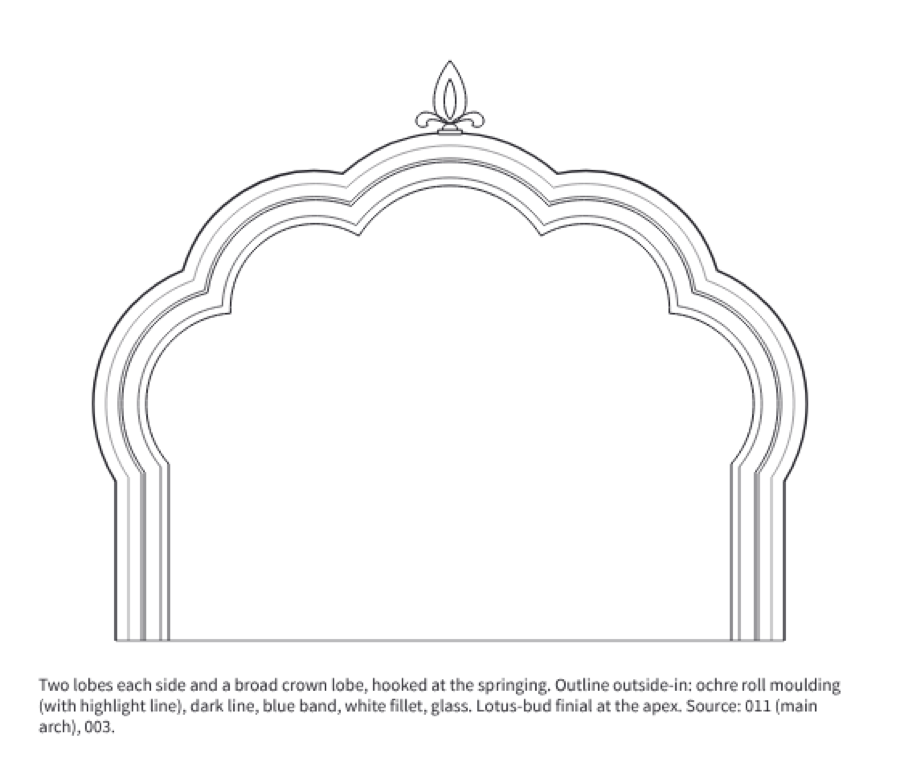
How it is drawn
- Draw a semicircle from centre O over the opening.
- Divide it into equal parts: five, seven, nine or thirteen.
- Over each part draw a short arc that bows outward: a lobe. Its centre lies on the line from O through the middle of that part.
- Where two lobes meet, a sharp point is left pointing into the opening: the cusp.
- Keep the number odd, so that one lobe always crowns the centre line.
The story
The lobed arch came to India with Islamic architecture and was refined in the seventeenth century, when Mughal builders under Shah Jahan made the cusped arch the standard frame for halls, niches and windows. Rajput builders took it up, and in the mirror palaces almost every opening is cusped.
The lobes are counted. Small windows carry five; the niches of the Amer Sheesh Mahal carry nine; the grandest marble arches carry thirteen in two stepped rows.
Why it matters
A plain arch is a hole in a wall. A cusped arch is an opening flower: each lobe is a petal, each cusp a point where the petals meet. The many small curves also catch light one by one, which is why the edge seems to shimmer even in plain plaster.
In our mirrorsMehrab · Chhota Mehrab · Dwar · Arch Glow · Neon Arch
One shape, two circles
कमल · kamal, the lotus
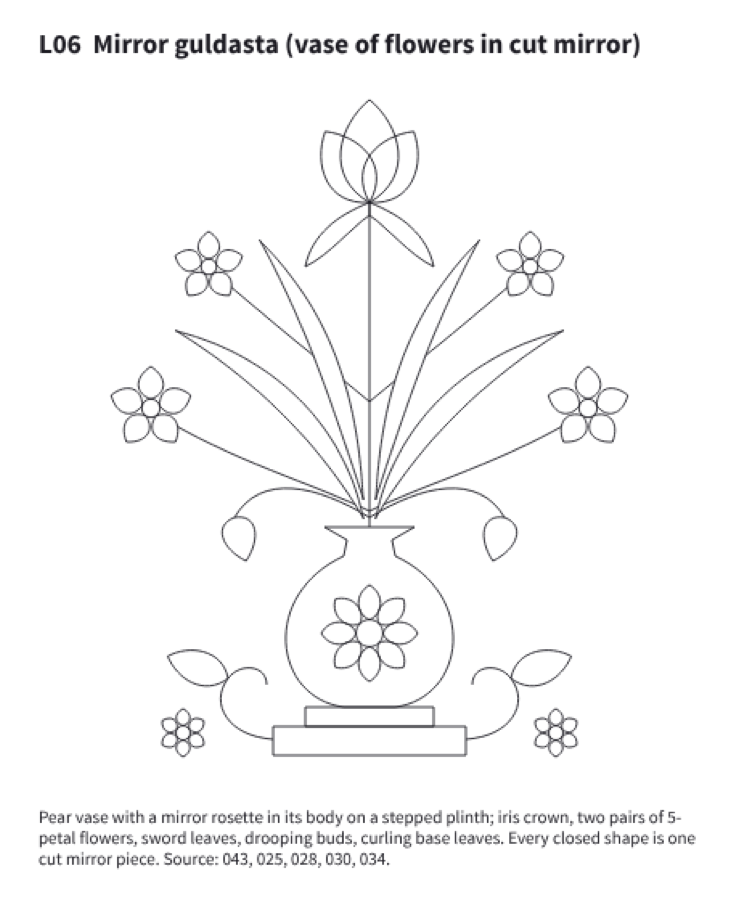
How it is drawn
- Draw a circle, then a second circle of the same size whose edge passes through the first circle’s centre.
- The almond shape where they overlap is the vesica.
- Narrow it and it is a leaf; widen it and it is a petal.
- Stand its upper half on two straight jambs and it is the pointed arch.
- Pinch its base and swell its middle and it is the lotus bud that sits on top of every arch and dome.
The story
The lotus grows from the mud of a pond and flowers clean above the water. In Indian art it stands for purity and for unfolding, and it is the seat of the goddess Lakshmi and of Brahma. Its closed bud crowns domes, arches and pavilions; its open flower spreads across ceilings.
Because the petal, the leaf, the bud and the pointed arch all come from the same two circles, they share one proportion, and they sit together naturally on a single wall.
Why it matters
Here geometry and meaning are the same thing. One construction gives the whole plant: leaf, petal and bud. A wall drawn from it feels like one family of shapes rather than a collection, which is the quiet reason palace ornament looks calm even when it is dense.
In our mirrorsKamal Oval · Jharokha Shelf
The rosette and the sun-wheel
अष्टदल · ashtadal, the eight petals
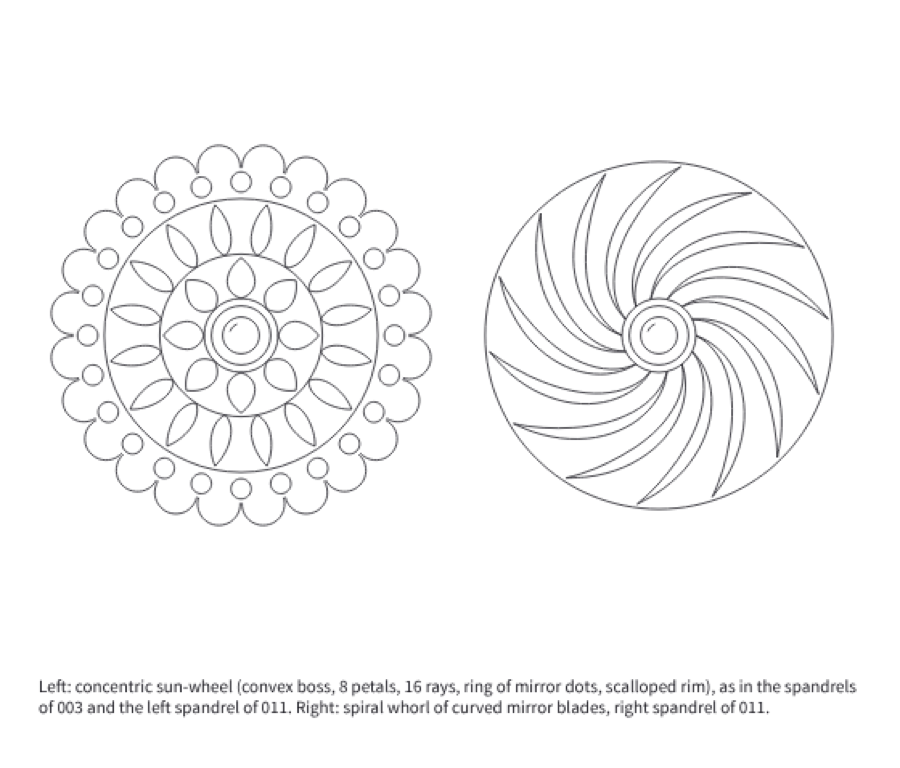
How it is drawn
- Draw a circle and divide it into sixteen equal parts.
- On the eight main lines, place eight vesica petals, tip outward.
- On the eight lines between them, draw rays.
- Close the centre with a boss: two small circles, one inside the other.
- For the whorl, bend every ray into the same curve, so the wheel seems to turn.
The story
The eight-petalled lotus, ashtadal kamal, is one of the oldest diagrams in Indian art. Its eight petals point to the eight directions, and it sits at the centre of temple ceilings and mandalas.
In the mirror rooms of Mehrangarh it becomes a sun. The Rathore rulers who built the fort trace their line to the Sun, and in the corners of their mirror hall a sun-wheel of glass catches the lamplight.
Why it matters
A circle is the hardest shape to place on a wall and the easiest to look at. The rosette solves the awkward triangle of space beside an arch, the spandrel, by filling it with something perfectly centred. Radial symmetry gives the eye a point of rest.
In our mirrorsSurya · Jute Surya
Thikri and the convex mirror
ठीकरी · thikri
How it is drawn
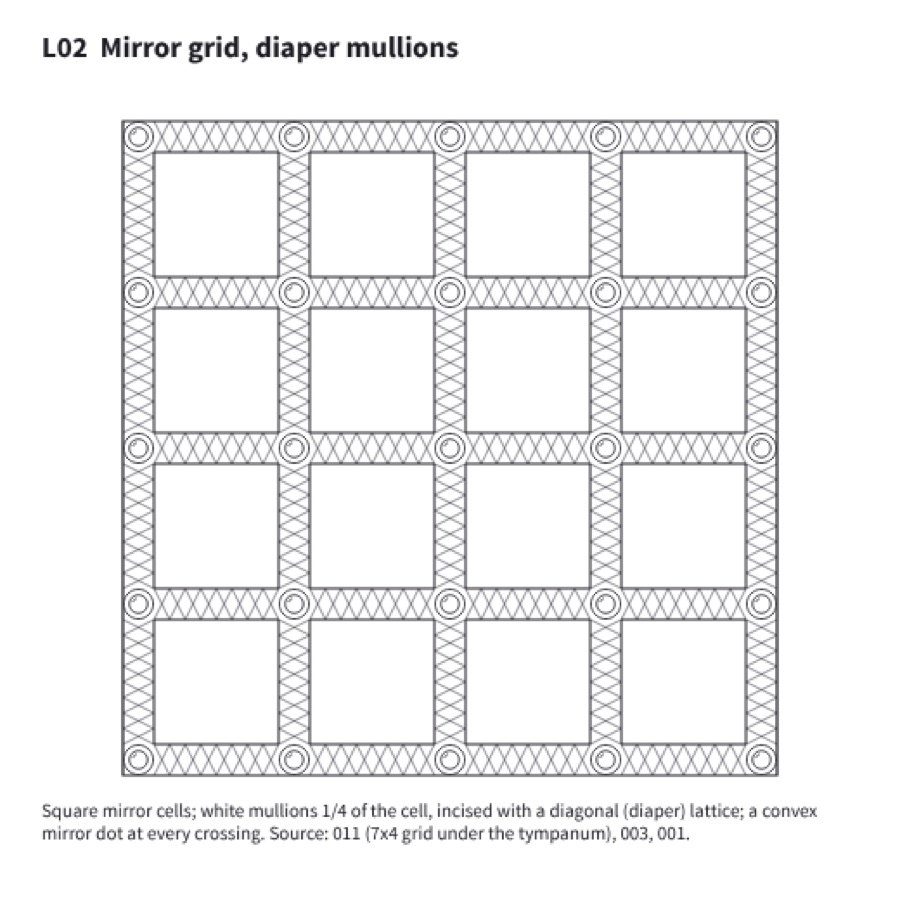
- Traditional mirror glass was blown as a bubble, silvered on the inside and broken into pieces.
- Every piece keeps the curve of the globe: it is slightly convex.
- Cut small and set into wet lime plaster, the pieces are thikri.
- Cut round, they are discs that each reflect a whole room in miniature.
- Set in a grid with a disc at every crossing, they turn a wall into a field of points of light.
The story
Thikri is the craft of setting cut mirror into lime plaster, piece by piece, along lines drawn on the wet wall. The halls built this way are the sheesh mahals, the palaces of glass.
In an age of oil lamps and candles, light was precious. A room lined with convex mirror multiplied every flame. It is said that in the Sheesh Mahal of Amer a single candle turns the ceiling into a night sky full of stars.
Why it matters
Thikri makes light itself the material of the art. The pattern is drawn in plaster, but what you see is reflection: it changes as you move and as the flame moves. A convex piece shows not your face but the whole room, small and bright, which is why these walls feel alive.
In our mirrorsMoti Round · Make-up Arch · Sheesh Panel
The jaali and the eight-pointed star
जाली · jaali
How it is drawn
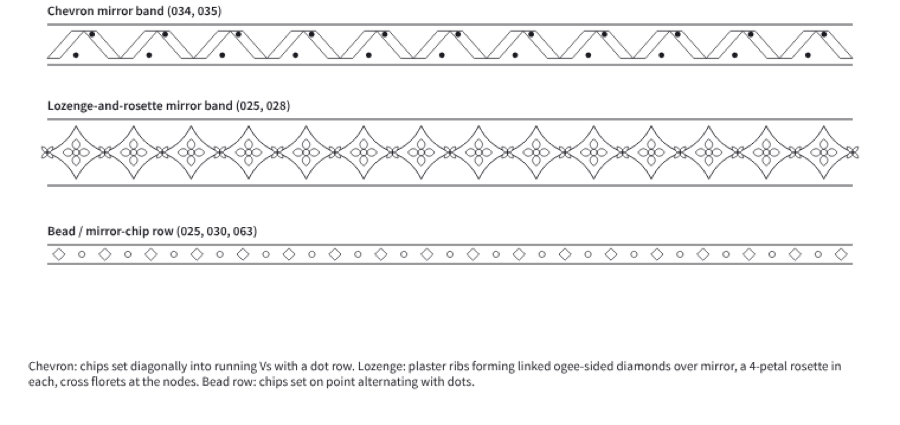
- Draw a square, then the same square turned by 45°.
- Their outline together is an eight-pointed star.
- Repeat the star on a grid, point to point.
- Between every four stars a cross-shaped opening is left.
- Cut the openings through stone, or fill them with mirror, and the lattice is a jaali.
The story
A jaali is a pierced screen. In a desert climate it does three things at once: it breaks the hard sun into soft light, it lets the wind pass and cool the room, and it lets people inside see out without being seen.
Its patterns are built from star polygons like this one, repeated without end, so a screen of any size can be cut from the same unit.
Why it matters
The jaali is ornament that works: pattern that is also shade, air and privacy. Its light falls on the floor as a second drawing that moves through the day. Repetition without a centre gives a calm, endless field.
In our mirrorsJaali Panel · Taaron ki Chhaon
The fish-scale
the scale band
How it is drawn
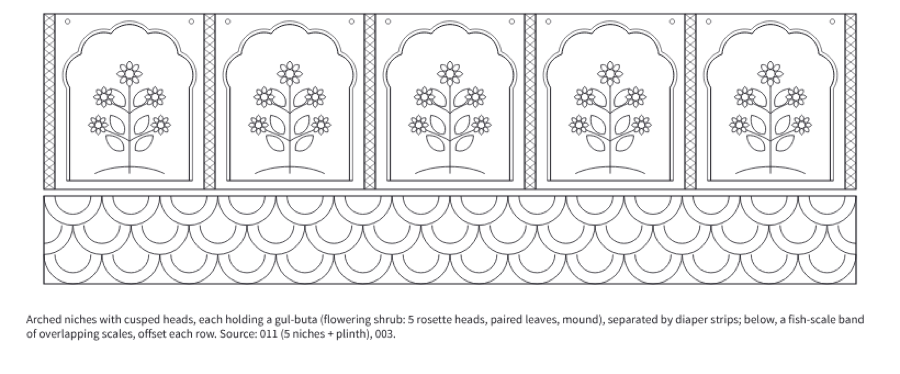
- Choose one radius.
- Draw a row of half-circles side by side, all hanging downward.
- Shift the next row along by one radius and lower it by one radius.
- Each half-circle now tucks between two above it, like overlapping scales.
The story
The fish-scale band runs along the base of the mirror room at Mehrangarh, in grey-blue glass. Overlapping scales appear on roof tiles, on armour and in water patterns across Indian and Persian art, and the motif is often read as water.
In a desert palace, water was the greatest luxury, and courts were built around pools and fountains. A band of scales at the foot of a wall reads like a reflecting pool.
Why it matters
It is the simplest repeat there is: one radius, one move. Because it has no single direction, it settles the bottom of a composition without weighing it down.
In our mirrorsRekha Floor
The peacock
मोर · mor
How it is drawn
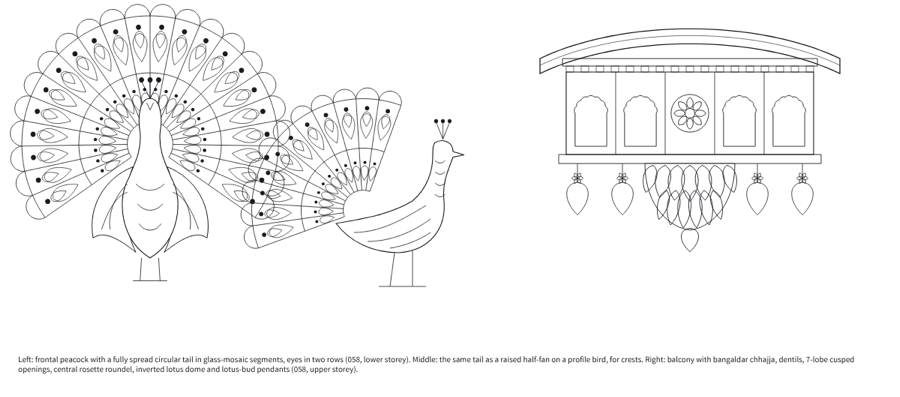
- Draw a half-circle and divide it into twelve equal sectors.
- Draw two rings inside it.
- On the inner ring, place an eye on each sector line.
- On the outer ring, place the eyes between the lines, offset by half a sector, so the two rows interlock.
- Each eye is a vesica with a circle at its heart.
The story
The peacock is India’s national bird. It dances when the monsoon clouds gather, so it belongs to the season of rain and renewal, and a peacock feather crowns Krishna.
In the Mor Chowk, the Peacock Court of the City Palace, peacocks in glass mosaic spread their tails across the walls. The three peacocks there are said to stand for the seasons: summer, winter and the monsoon.
Why it matters
The peacock’s fan is pure radial geometry, a rosette that has come alive. That is why it suits mirror work so well: the eyes catch light the way a real tail does.
In our mirrorsMor · Peacock Glow
The curved eave
बंगलादार · bangaldar
How it is drawn
- Draw a long, shallow arc from a centre far below it.
- At each end, turn the curve sharply downward.
- Draw a second line inside the first: the thickness of the eave.
- Hang lotus-bud drops beneath it at an even spacing.
The story
In Bengal, village huts were roofed with bamboo and thatch that bent under its own weight, so the roof curved and the rain ran off its drooping ends. Mughal and Rajput builders carried that curve into stone and marble as a royal canopy, and called it bangaldar, “from Bengal”.
It crowns the jharokha balconies of Rajasthan, and on the balcony of the Mor Chowk it sits over a row of cusped openings hung with lotus buds.
Why it matters
A straight line is static. A bangaldar line seems to breathe: it rises, holds, and lets go at the ends. It turns a shelf or a ledge into shelter.
In our mirrorsJharokha Shelf · Console Set
Our mark: the reflected arch
जोधपुरी आईना
How it is drawn
- Draw the jharokha arch, as in chapter I.
- Draw a horizontal line beneath it: the mirror line.
- Reflect the arch in that line.
- Above the line is the window; below it, the reflection.
The story
A jharokha is where you look out. A mirror is where you look in. Our mark puts both on one line: the arch of the palace window and its reflection, as it would appear in still water or in glass.
The name is set twice. In Devanagari, जोधपुरी आईना in Vesper Libre, whose flared strokes recall carved inscriptions; in English, JODHPURI AAINA in Cinzel capitals, drawn from Roman stone letters. Lines are thin brass, never a gold fill, as in the palace rooms, where gold is a drawing on light, not a surface.
Why it matters
Every mirror we make carries one curve from these pages. The mark carries the first of them, the jharokha, and the idea behind all of them: that a mirror can be a window.
In our mirrorsJharokha Mini · Peacock Glow
When the curves come together
In the palaces the curves are never alone. They are layered in a fixed order from the outside in: an edge, a row of light, one feature band, a calm line, the cusped arch, and the glass, with a crown above and a base below. Our Art collection draws three palace walls in full, in that order.
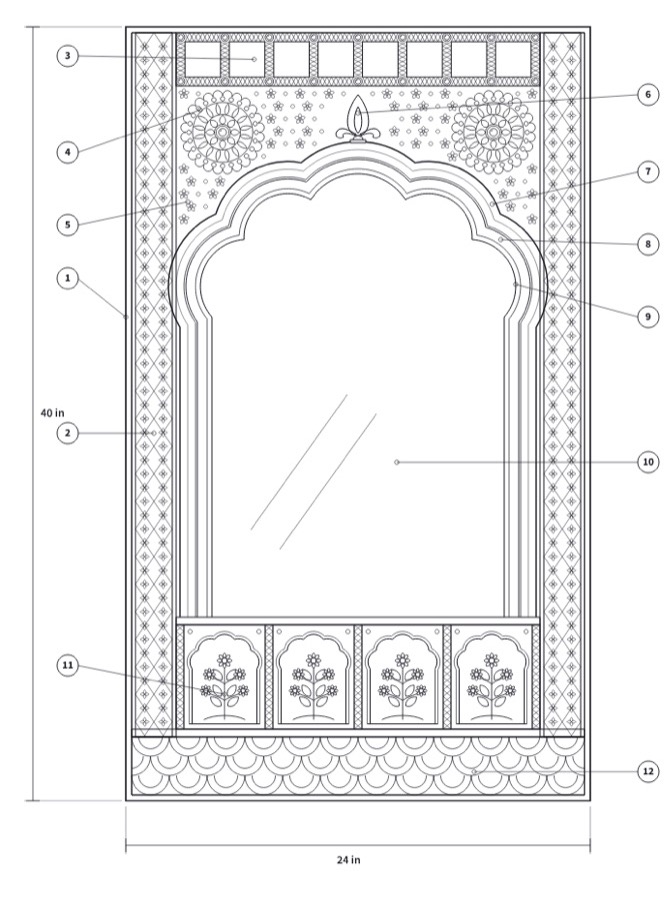
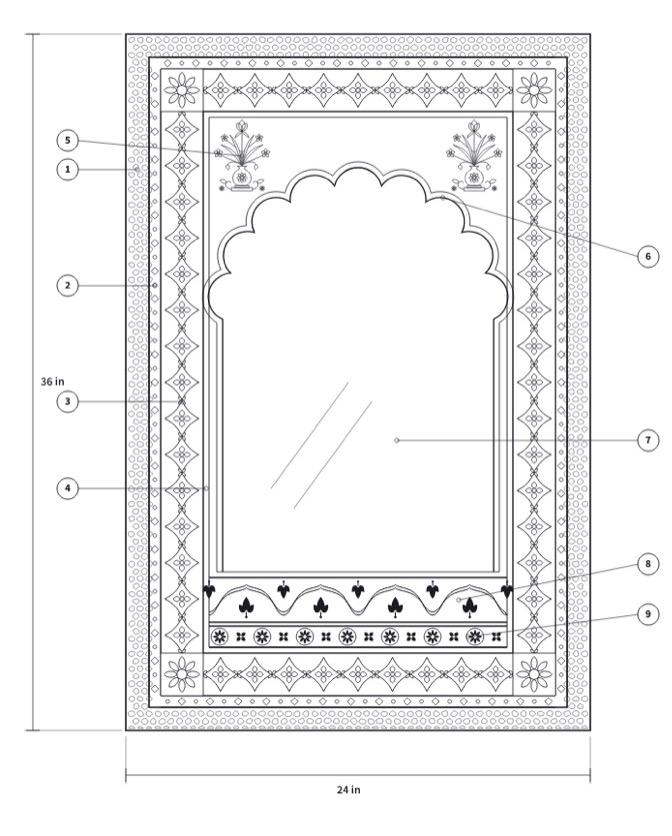
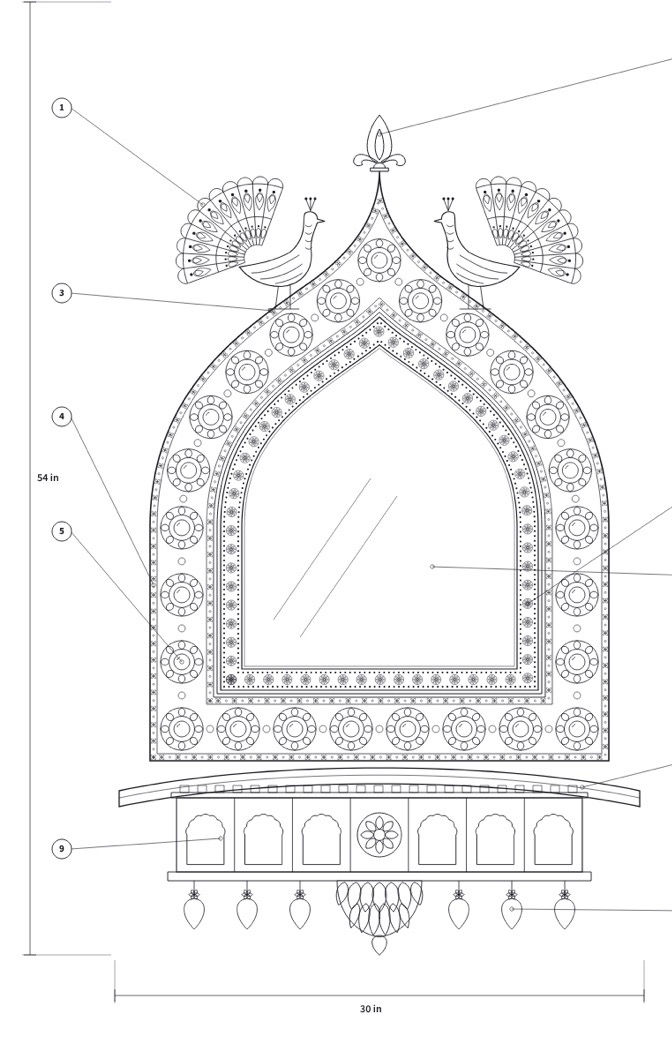
Our everyday mirrors do the opposite. Each keeps a single curve and leaves the rest of the glass quiet, so the curve can be seen.
Where to see these forms
- Mehrangarh Fort: the Sheesh Mahal and the Phool Mahal
- Amer Fort: the Sheesh Mahal and its niches
- The City Palace: the Mor Chowk and its mirror rooms
All drawings on this page are our own, made for this study.